Patient Education for Hypertension: What to Teach First
A home monitor on its own does not lower blood pressure.
A patient learns at a routine visit that their blood pressure is high. They feel fine. They leave with a prescription, a follow up date and a suggestion to buy a home monitor.
Patient education for hypertension should start with three things. High blood pressure usually has no symptoms. Home readings need a method and a plan for the numbers. And what the patient eats changes blood pressure. A home monitor on its own does not lower blood pressure. In an analysis of 25 trials, the benefit came from the support around the readings.
The rest can wait for the next visit.
High blood pressure usually has no symptoms
Many patients believe they can feel their blood pressure.
In a study of 230 patients interviewed about hypertension (opens in a new tab), researchers asked whether they could tell when their blood pressure changed. Among patients new to treatment, 71 percent said yes. Among patients in continuing treatment, 92 percent said yes. Patients new to treatment were more likely to drop out if they had reported symptoms at their first visit. The same was true if they saw the disease and its treatment as short term.
The study is small and dates from 1985. Its lesson still travels: a patient who takes the pill only on days with a headache is following a model of illness, not ignoring advice.
"Because high blood pressure usually has no warning signs or symptoms, many people do not know they have it," the CDC says (opens in a new tab). That sentence belongs on the written plan, where the patient can read it again on a day they feel well.
A home monitor alone does not lower blood pressure
Home readings are widely recommended. A joint policy statement (opens in a new tab) from the American Heart Association and the American Medical Association endorses them and asks for a standardized protocol. It notes that the benefit is greatest when monitoring comes with other support.
The trials show why that last point matters.
An individual patient data meta-analysis (opens in a new tab) drew on 25 trials of self monitoring. At 12 months, self monitoring alone showed no clear effect on clinic systolic pressure: 1.0 mm Hg lower, with a confidence interval that crossed zero. When monitoring came with intensive support, systolic pressure was 6.1 mm Hg lower. The support included medication adjustment by doctors, pharmacists or patients, education, and lifestyle counselling.
An earlier review funded by the Agency for Healthcare Research and Quality (opens in a new tab) looked at 52 studies. Home monitoring alone lowered blood pressure at 6 months but not at 12. With additional support, systolic pressure was 3.4 to 8.9 mm Hg lower at 12 months in good quality studies. Evidence on heart attacks, strokes and other clinical outcomes was insufficient.
So the teaching is not "buy a cuff." It is how to measure, where to write it down, and who looks at the numbers.
How to teach home blood pressure readings
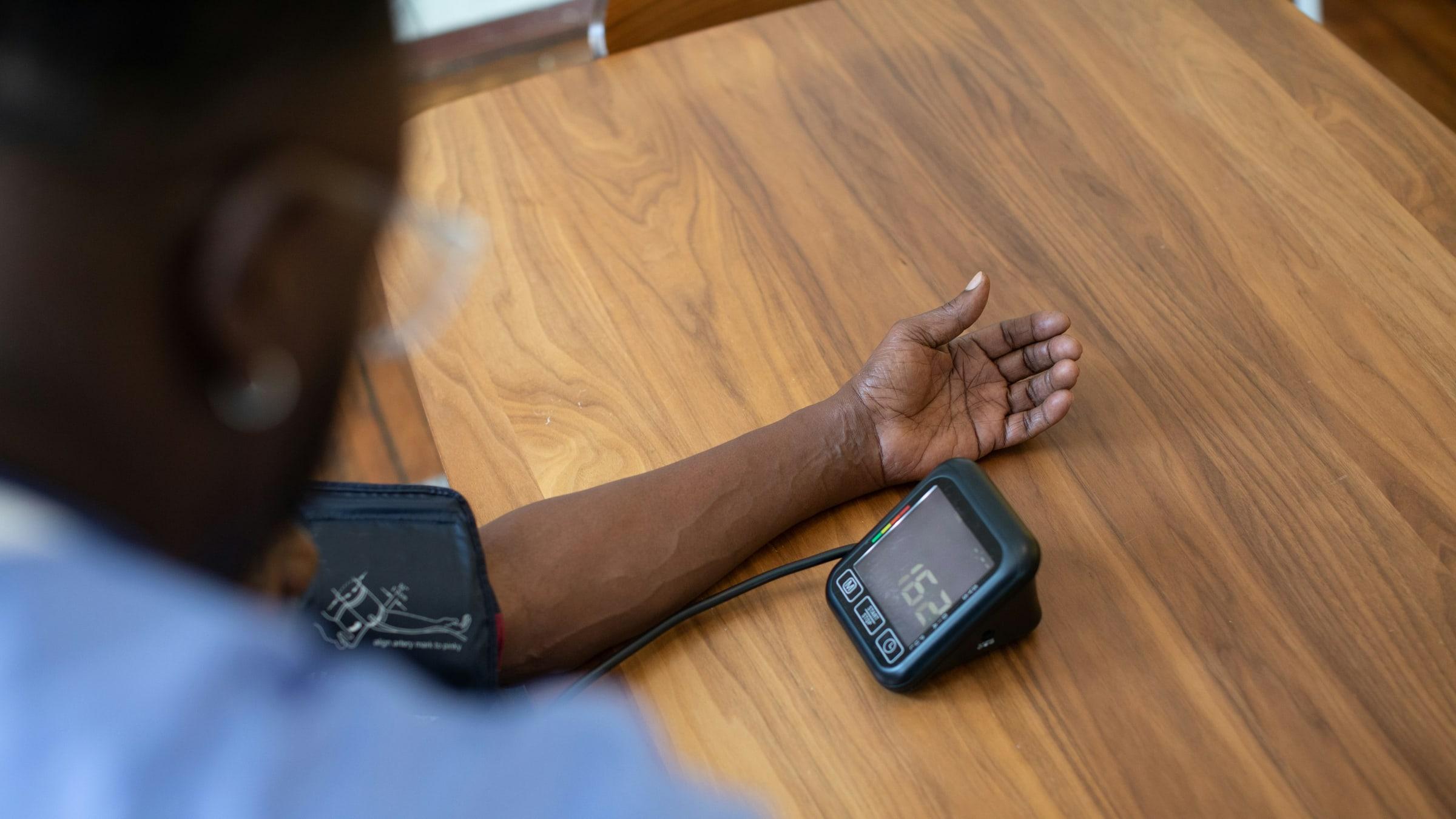
The CDC's steps for an accurate reading (opens in a new tab) fit on one page. Before and during each reading, the patient:
Does not eat or drink anything for 30 minutes.
Empties the bladder.
Sits for at least 5 minutes in a chair with the back supported, feet flat and legs uncrossed.
Rests the arm on a table with the cuff at chest height, on the bare upper arm.
Does not talk.
The same page advises measuring at the same time each day, taking at least two readings one or two minutes apart, and keeping a log. It also says "a member of your health care team can show you how to use one correctly and how often." The office can do that once, with the patient's own device.
The CDC page cannot say what the numbers are for. The written plan can. It should say when to bring or send the log, who reviews it, and which readings mean a call to the office before the next visit. Those thresholds are the clinician's decision, written in the clinician's own numbers.
Food changes blood pressure
The DASH Sodium trial (opens in a new tab) randomized 412 adults to a typical American diet or the DASH diet, rich in vegetables, fruits and low fat dairy. Within each diet, they ate high, intermediate and low sodium levels for 30 days each.
Systolic pressure was lower on the DASH diet at every sodium level, and lower still with less sodium. Compared with the typical diet at high sodium, the DASH diet at low sodium left systolic pressure 11.5 mm Hg lower in participants with hypertension.
The food was provided. The authors noted that the long term benefit depends on whether people can keep the changes, and on the availability of lower sodium foods. A home log gives the patient a way to see whether one change in diet shows up in their own readings.
A first visit teaching plan for hypertension
The written plan from the first visit can be short. Four parts cover it.
What it is. High blood pressure usually causes no symptoms. Feeling well does not mean it is controlled, and the medication is taken on good days too.
How to measure. The CDC steps above, the time of day for readings, and where to record them.
What to do with the numbers. When to bring or send the log, who reviews it, and the readings that mean calling the office.
What to change first. One change in food the patient chose, such as less salt, and the time and meal each medication goes with.
A plan for hypertension, or for a first medication such as lisinopril, can carry these parts home. The clinician still sets the target and the thresholds.
The reviews of patient education found larger effects when it taught a skill rather than only giving information. Taking a correct reading and knowing what to do with it is that kind of skill.
Blood pressure is silent. The plan for it should not be.
Let's Complete the Care.