Physician's Sticky Notes: What the Research Supports
A short written request can connect the exam room to a care plan at checkout.

A physician explains a new diagnosis and a new medication. The patient understands the conversation in the room. At the front desk, they remember that something should be printed, but cannot quite remember the name.
A sticky note offers a simple way to carry that information. The doctor writes the names of the care plans to print, gives the note to the patient, and asks the front office to hand over the plans before the patient leaves.
Research on paper reminders gives this idea a reasonable foundation. Research on sticky notes themselves is more mixed.
What studies found about sticky notes
In 2005, Randy Garner published four experiments on handwritten sticky-note requests (opens in a new tab). In the first, 150 university faculty members received the same survey. Some received a handwritten request on a sticky note. Others received the same request written directly on the cover letter, or no added request.
Seventy-six percent returned the survey when the request was on a sticky note, compared with 48 percent when it was written on the cover letter and 36 percent with no added request.
The message mattered too. In a second experiment, a sticky note with a written request increased returns. A blank sticky note did not significantly outperform having no note.
Later findings were less encouraging. In a randomized study of 826 older adults (opens in a new tab), Rodgers and colleagues found that handwritten and printed sticky notes did not improve questionnaire returns. Their combined analysis of three trials found no benefit either.
These studies tested survey requests. They did not test a doctor handing a note to a patient so the front office could print a care plan.
Paper reminders have stronger evidence in clinical care
In a 2019 Cochrane review of 63 studies (opens in a new tab), Pantoja and colleagues examined reminders prepared manually and delivered on paper to healthcare professionals. Most studies took place in outpatient settings.
Compared with usual care, reminders alone probably improved completion of recommended clinical actions. Across 39 comparisons, the median improvement was 8.45 percentage points. The actions included ordering tests, prescribing medications and discussing care with patients. Whether the reminders improved patients’ health outcomes remained uncertain.
That supports testing a paper prompt for a specific task at checkout. It does not establish that the proposed PENCIL Health handoff has already been proven.
Front office delivery has already been studied
In 2016, Curtis and colleagues studied 141 patients receiving new or changed prescriptions (opens in a new tab) at one internal medicine clinic. One-page medication sheets were printed at checkout, where clerical staff were asked to hand them to patients with their after visit summary.
The follow-up analysis included 122 patients. Assignment to the medication-sheet group and self-reported physician counseling were each associated with better understanding of medication risks.
Delivery was imperfect. Only 70 percent of intervention patients reported receiving the sheets. Clinic staff described printer problems as one reason.
The study provides a clinical example of front-office staff delivering written medication information. It also shows why clinics need to check whether patients actually receive it.
What the doctor can write on the note
A medical term can be useful for finding the right plan. The patient should not have to remember or pronounce it to obtain their written instructions.
For a patient newly diagnosed with hypertension and starting lisinopril, the doctor could write:
Please print these PENCIL Care Plans:
Hypertension (high blood pressure)
Lisinopril
Requested by Dr. __________
☐ Printed and handed to the patient
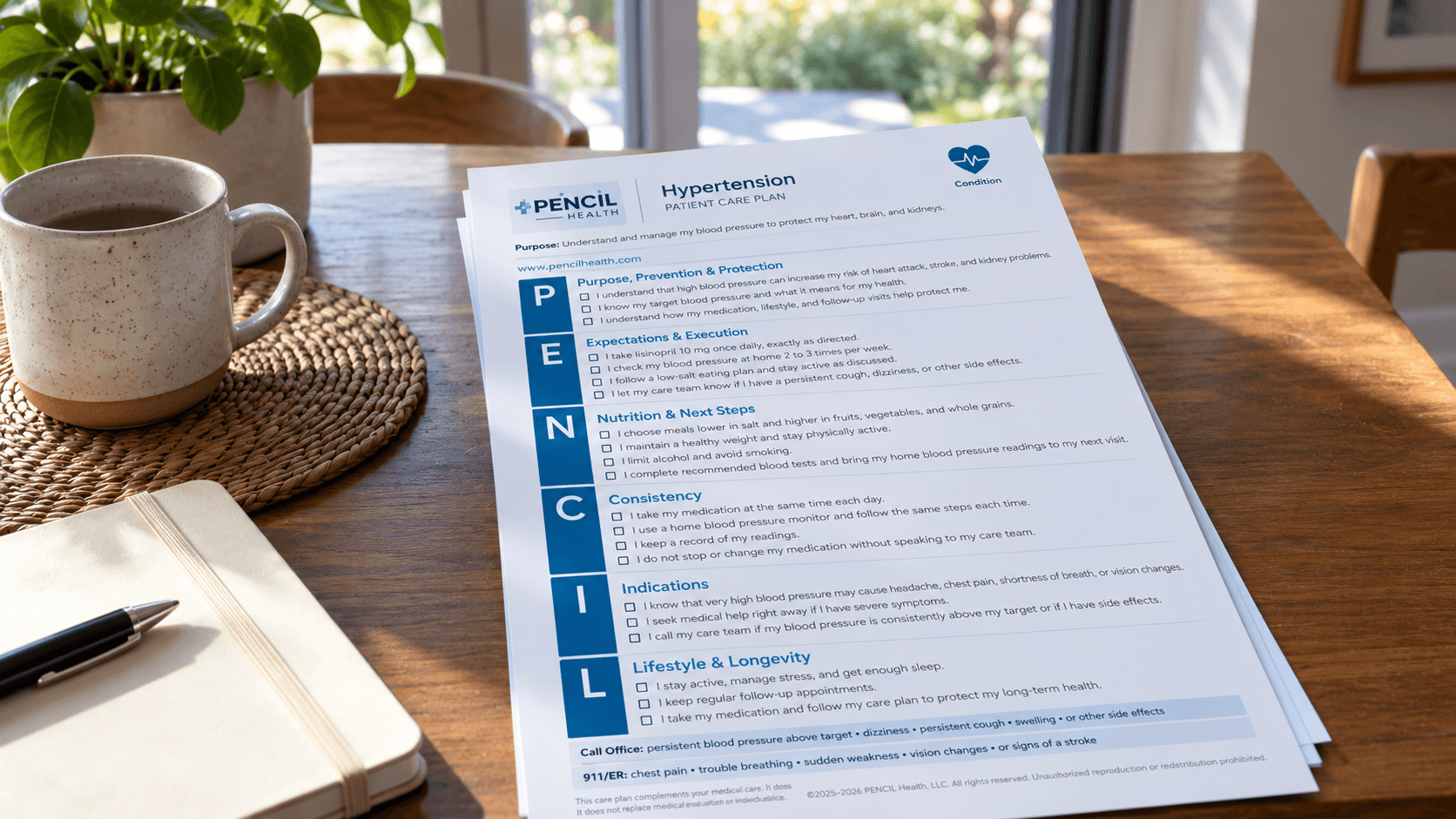
The note carries the exact names to checkout. The printed care plans explain what those names mean and what the patient should do next.
A five step handoff from the exam room to checkout
Choose the plans. The clinician selects the condition, medication or procedure plans that match today’s discussion and treatment.
Write the request clearly. Use the exact plan titles and a specific instruction to print them. Avoid abbreviations staff would have to interpret.
Explain the next step. Tell the patient, “You will receive a PENCIL Care Plan today. Please give this note to the front desk so we can print it for you.”
Hand over the plans. Staff print the clinician-selected plans and give them to the patient during checkout. An unclear request goes back to the clinical team.
Confirm completion. Mark the note after the plans are handed over. Printing alone does not complete the handoff.
The clinician remains responsible for explaining treatment and making sure the written information matches the patient’s instructions. The patient carries the request; the clinic remains responsible for completing it.
Measure whether patients leave with the plan
Measure the percentage of patients leaving with a written care plan before introducing the notes, then repeat after a short trial. Record missed handoffs and unclear requests so the process can be adjusted.
A sticky note is useful when it helps put the right care plan in the patient’s hands. That is the result to measure.
Every patient deserves to leave with a clear written plan they can use at home.
Let’s Complete the Care.