How to Write Patient Education Materials Patients Can Use
Most of what makes a handout work is decided before the first sentence is written.

A patient goes home with a handout, reads the first paragraph at the kitchen table, and puts it in a drawer.
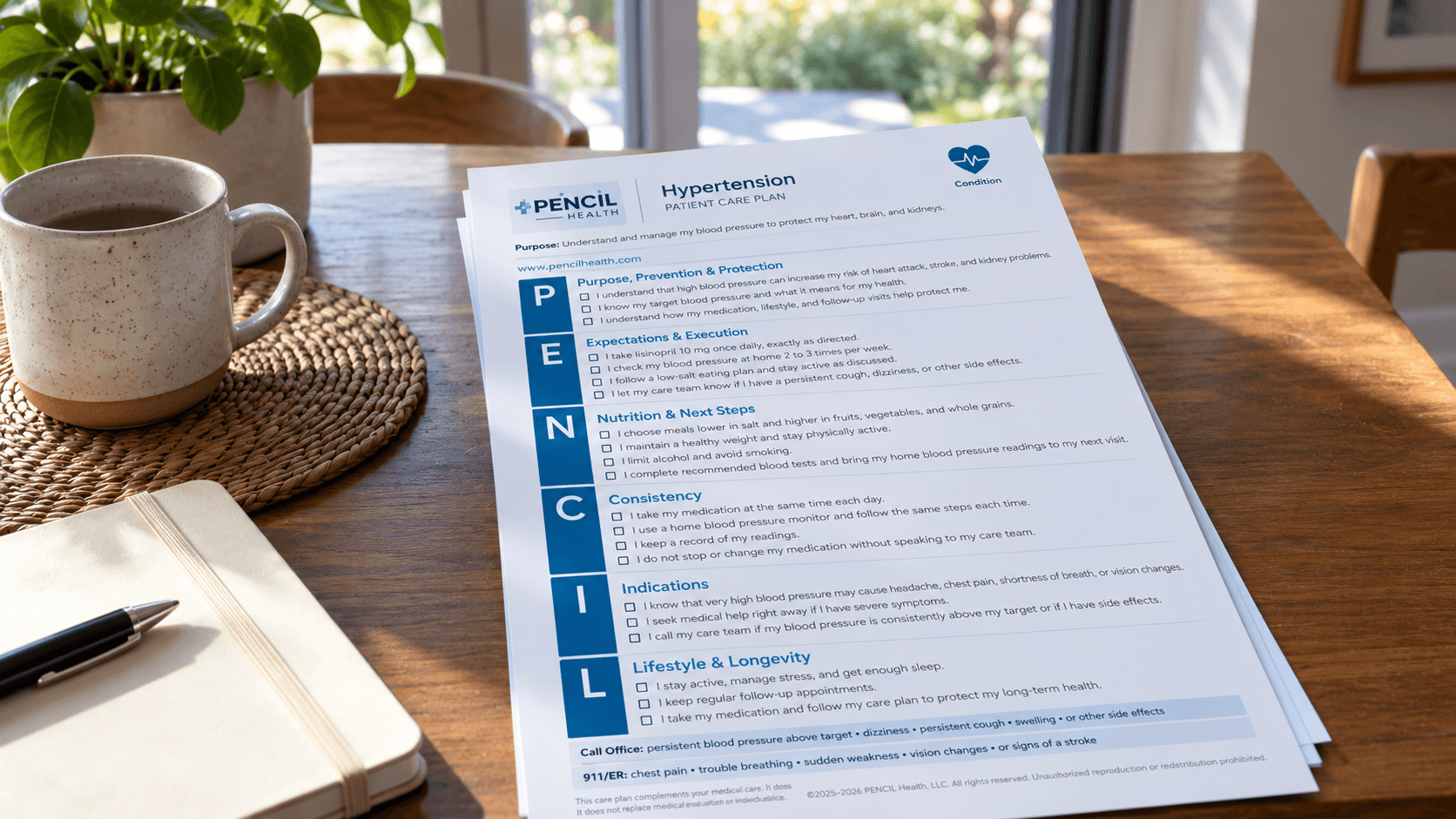
To write patient education materials patients can use, start with the one thing the patient must do, and put it first. Then cut the page to the few points that matter and write each instruction as a concrete step. Group the steps under plain headings, add a picture only where it helps, and test the result with patients before printing a stack of copies.
Most of what makes a handout work is decided before the first sentence is written.
What patients remember shapes how a handout should be written
In 1979, Philip Ley reviewed the research on memory for medical information (opens in a new tab). The more patients were given, the more they forgot. Instructions and advice were forgotten more often than other information. Statements presented first, and statements patients saw as important, were remembered better.
He named four things that reduced forgetting: simpler language, explicit categories, repetition, and concrete, specific advice instead of general statements.
A more recent study points the same way. Laws and colleagues recorded 189 outpatient visits (opens in a new tab) and interviewed patients a week later. Only 49 percent of decisions and recommendations were recalled accurately without a prompt. Patients without a high school diploma recalled 38 percent; college graduates recalled 65 percent. The more items a visit contained, the worse the recall, but only for the less educated patients.
The patients with the least formal education were the ones a long list lost first.
Six steps for writing patient education materials
These steps follow from that evidence.
1. Name the one thing the patient must do. Before writing, finish this sentence: "After reading this, the patient will ____." If it takes three sentences to finish, the handout is trying to do too much.
2. Put the most important instruction first. Patients remember what comes first and what they believe matters. Background on the condition can wait until after the action.
3. Cut to the few points that matter. Every added item competes with the others. A handout that covers the diagnosis, its causes, every medication option and the long term outlook will be remembered for none of them.
4. Write each instruction as a concrete step. Compare "Take your medication as directed" with "I will take ____ with breakfast and ____ with dinner, starting ____." Leaving blanks for the clinician to fill in keeps the clinical decision with the clinician.
5. Group the steps under plain headings. Explicit categories helped recall in Ley's work. Headings such as "What to do each day" and "When to call us" also let a patient find the answer again a week later.
6. Add a picture only where it shows something. A review of pictures in health communication (opens in a new tab) by Houts and colleagues found that pictures closely linked to the text can increase attention and recall. A drawing of how to stretch a foot helps. A stock photo of a smiling patient does not.
Check whether the handout is actionable, not only readable
A readable handout can still leave a patient unsure what to do.
The Patient Education Materials Assessment Tool, or PEMAT, from the Agency for Healthcare Research and Quality, scores materials on two separate scales: understandability and actionability. In the study that developed it (opens in a new tab), comprehension scores were 76 percent for actionable materials and 63 percent for poorly actionable ones. Actionability scores tracked consumer results; understandability scores did not. That was a small study, of 47 consumers, and it is one reason to score both scales rather than one.
The four pillars of better patient education describe what an actionable plan includes.
Test patient education materials with patients before printing
Hand the draft to a patient or two who fit the audience. Ask them to tell you, in their own words, what they would do first. Where they hesitate or get it wrong, the handout needs work, not the patient.
The same test works on a handout already in use, such as instructions before a colonoscopy, for plantar fasciitis, or for starting metformin.
A good handout is not the one that says the most.
It is the one the patient takes out of the drawer.
Let's Complete the Care.