After Visit Summary Template: What the Research Says to Include
Adding more to the page did not help patients remember more.
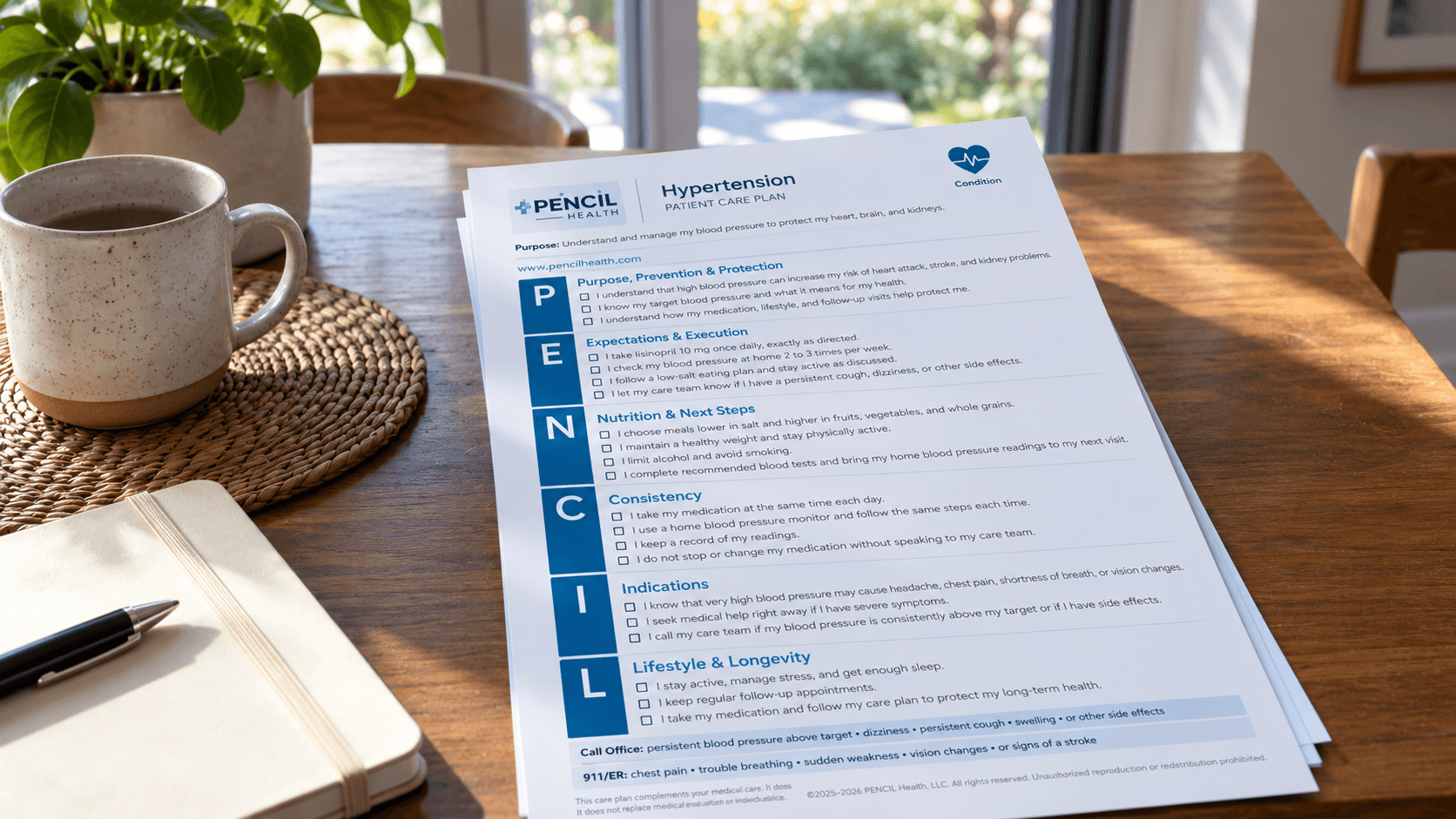
A patient opens the portal the evening after a visit and finds a summary several screens long. The plan is in there somewhere, below the vital signs and the allergy list.
A useful after visit summary template puts the plan first. It says what we found, what changed and why, what the patient should do next, and when to call. It keeps one current medication list, gives the reason for each new medication or referral, and leaves out what the patient does not need to act on.
That is not how most summaries are built today.
What studies found in real after visit summaries
In 2016, Salmon and colleagues examined clinical summaries from 13 practices (opens in a new tab) across the United States, produced by seven different record systems. The median font size was 10 point. The median reading grade level was 10. Content, and the order of that content, varied from one summary to the next.
The physicians at those practices were not convinced either. Only 46 percent found the summaries helpful for clarifying medications, and 38 percent for conveying follow up.
Length is not the answer. In a randomized trial of 272 primary care patients (opens in a new tab), Pavlik and colleagues gave each patient one of four versions of the summary: minimum, intermediate, maximum or standard. Medication recall was about 53 percent at two days and 52 percent at three weeks, with no difference between the groups. Patients liked receiving a summary. Adding more to the page did not help patients remember more.
What patients want from an after visit summary
When Federman and colleagues held focus groups and interviews with 39 patients and 56 clinicians (opens in a new tab), patients had clear preferences. Many wanted the reason for each medication and referral stated. Some were confused by separate lists of started, stopped and changed medications. Patients and doctors both preferred a single current list. Some saw it as useful for sharing with family.
A smaller study pointed the same way. Clarke and colleagues asked 29 primary care patients (opens in a new tab) which parts of a visit note mattered most to them. The plan and the assessment ranked near the top for patients with an acute illness and for those with a chronic disease.
Patients read the summary for the plan. So the plan should come first.
A seven part after visit summary template
Each part answers a question the patient will have at home. The clinician fills in the content; the order does the rest.
What we found today. The diagnosis, in the same plain words used in the room.
What changed. Each new, stopped or adjusted medication, with one line on why.
Your current medications. One list, not three.
What to do next. Concrete steps, written so the patient can say them back, such as "I will take ____ each morning, starting ____."
Tests and referrals, and why. One line on the reason for each, which patients in Federman's groups asked for.
When to call us. The symptoms that need a call, and the number to use.
Next appointment. The date, or who will call to schedule it.
Parts 4 and 6 do the most work, and they are the ones most often left generic. What makes a next step actionable is set out in the four pillars of better patient education.
A patient newly diagnosed with hypertension and starting lisinopril is a good test. Parts 2, 4 and 6 should be specific enough that a family member could read them and know what to watch for. The same is true for a new diagnosis of type 2 diabetes.
Writing the after visit summary is only half of it
A recent study measured whether patients opened the summary at all. Halvorson and colleagues analysed more than 6 million ambulatory visits (opens in a new tab) at one academic health system. Portal views of the summary rose from 20.8 percent of visits in 2018 to 37.6 percent in 2023. Physicians spent a median of 1.38 minutes per visit writing instructions. The digital summary was not viewed in 62.4 percent of encounters.
That study counted only portal views, so a patient who read a printed copy does not appear in it. Two findings still stand out. Instructions written by the physician were associated with higher engagement, 40.5 percent against 34.3 percent. And patients who did not speak English engaged 15 percentage points less than those who did.
A summary the patient never opens cannot help them. Handing it over, and pointing to the one step that matters, is part of the work.
Every patient deserves a summary that starts with the plan.
And every patient deserves to leave knowing what to do next, as the healthcare improvement we can start today argues.
Let's Complete the Care.