The Teach Back Method for Patient Education: What Studies Show
The newest and most careful review found something narrower than most guides describe.

At the end of a visit, a clinician asks, "Do you have any questions?" The patient says no and reaches for their coat.
The teach back method replaces that question with a request. The patient explains, in their own words, what they need to know or do, and the clinician explains again where the answer shows a gap. It is often described as a way to make sure patients understand. The newest and most careful review found something narrower than most guides describe. In randomized trials, teach back improved patients' confidence and their own reports of following the plan in the short term. It did not show a clear effect on knowledge.
That difference changes how we should use it.
What the teach back method is
The Always Use Teach Back toolkit (opens in a new tab) describes ten elements. The core of it is short.
Decide in advance the few things the patient must know or do. Explain one of them in plain language. Then ask the patient to explain it back, or show it back, before moving to the next. The toolkit calls this "chunk and check."
The request is framed as a check on the clinician's explanation, not on the patient. And the patient uses their own words, because a patient who repeats a sentence back word for word may not have understood it.
When the answer is wrong, the clinician explains differently and checks again.
What the evidence on teach back shows
Earlier reviews were positive. In 2016, Ha Dinh and colleagues (opens in a new tab) reviewed 12 studies of people with chronic disease. Results were positive, but not always statistically significant. In 2020, Talevski and colleagues (opens in a new tab) reported teach back effective in 19 of 20 studies, which measured very different outcomes.
The newest review is the most careful. In 2026, Vick and colleagues published a systematic review and meta analysis of 18 randomized trials (opens in a new tab) with 1,985 participants. What they found:
Knowledge: nine trials measured it, too inconsistently to combine. There was no clear pattern of effect, and the certainty of the evidence was very low.
Self efficacy: across five trials with 416 participants, teach back produced a large increase, with very low certainty.
Adherence to health behaviors: across seven trials with 571 participants, teach back produced a large increase, with low certainty.
Both pooled results had wide confidence intervals and substantial differences between studies. An earlier Veterans Affairs report (opens in a new tab) by the same team adds a detail worth knowing. All but one of its six adherence trials relied on what patients said they did.
Why the narrower finding still matters
A technique that leaves patients more confident and more likely to follow a plan, at least by their own account, is worth using. The Veterans Affairs report calls it a low risk strategy. What the evidence does not support is the stronger claim that teach back reliably produces understanding on its own.
It is also easy to skip. In a study of 74 patients with diabetes and limited health literacy (opens in a new tab), Schillinger and colleagues found that physicians checked recall or understanding in only 12 of 61 visits. That was a small observational study. In a later study of 189 outpatient visits (opens in a new tab), Laws and colleagues found teach back was rare.
How to use teach back in a busy visit
Start where a misunderstanding carries risk: a new medication, a dose change, the signs that mean call the office. A patient starting warfarin or metformin, or newly diagnosed with type 2 diabetes, is a good place to start.
One of the toolkit's examples, "I want to be sure I explained this clearly," puts the responsibility on the clinician. By contrast, asking "Do you understand?" invites a yes, and so does the question at the top of this article. When the patient cannot explain it, the toolkit suggests saying something like "I see I wasn't clear," then explaining a different way.
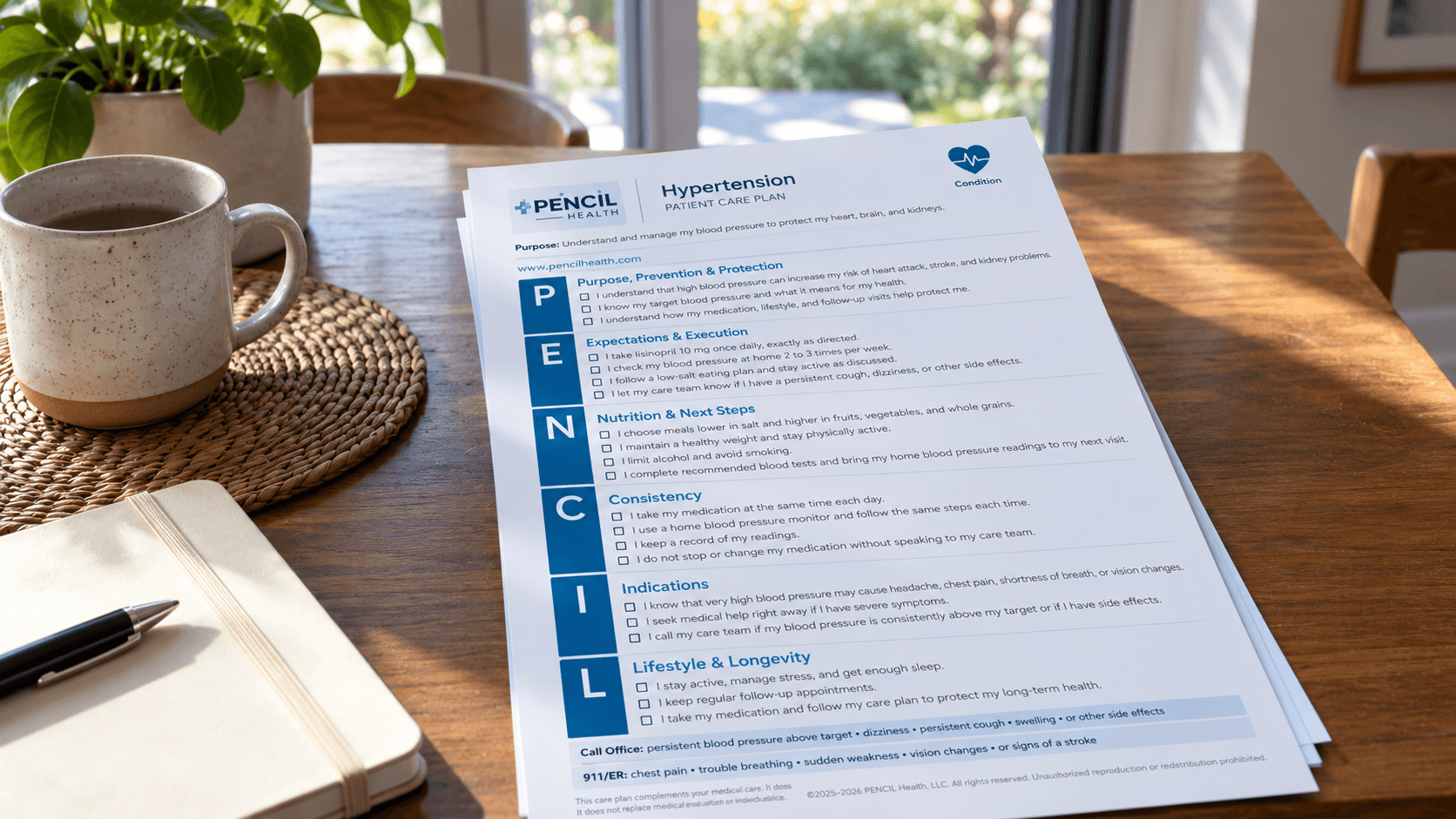
The toolkit also recommends marking the key points on a plain language handout during the conversation, so the patient leaves with the same steps they just explained. Asking what the patient will do first, the question in the four pillars of better patient education, is one way to begin.
The optional Pencil Check supports this: patients review each step and confirm what they will do next.
Teach back is not a test of the patient.
It is a test of how well we explained.
Let's Complete the Care.